How Are You Related? Visual Relationship Finder
Find out exactly how any two people in your family tree are connected — with a visual path, not just a label. “Second cousin once removed” finally makes sense.
In one paragraph
MyLegacySpace Relationship Finder shows how any two people in your tree are connected — with a visual path traced generation by generation, and a plain-English label like “second cousin once removed.” Unlike a text-only cousin calculator, you see the actual path, so the term actually makes sense. Available on the Family plan and higher.
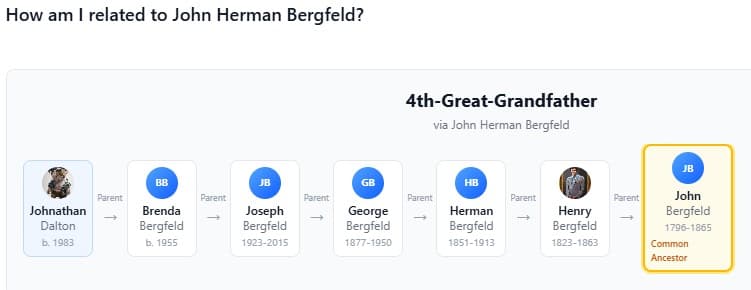
What is a relationship finder?
A relationship finder is a tool that shows how two people are related within a family tree — and how many generations apart they are. Instead of just a label, a visual relationship finder traces the path between them person by person, so you can see the actual connection rather than just counting cousins in your head.
Why visual paths beat text-only calculators
You see the actual path
Person by person, generation by generation. “Second cousin once removed” becomes a visible route through your shared great-grandparent.
Handles half, step, and in-law relationships
Modern families are complicated. The finder recognizes half-siblings, step-parents, adopted children, and in-laws without oversimplifying them into plain blood relations.
Works on huge trees
Trace the connection between ancestors you never met — as long as both are in your tree, the finder can find them across any number of generations.
Jargon, translated
“Second cousin once removed” — the finder shows what that actually means with a diagram and a sentence anyone can understand.
How it works
- 1
Pick two people from your tree
Select yourself and any other person in your family tree — an ancestor, a cousin, a newly-discovered relative, or a distant branch.
- 2
See the visual path
The finder draws a visual path connecting you, generation by generation. Each link on the path shows how that specific relationship works.
- 3
Read the plain-English label
The finder translates the path into words: "second cousin once removed," "great-great-grandfather," "half-aunt." No more squinting at a chart and counting generations.
Why MyLegacySpace
Most cousin calculators spit out a label and leave you to figure out what it means. We show the path. Because relationships aren't trivia — they're how you make sense of your family at the reunion.
Questions about relationship finding
- What is a relationship finder?
- A relationship finder is a tool that shows exactly how two people are related within a family tree. MyLegacySpace displays the connection visually — person by person, generation by generation — so you can see the path, not just a label like "second cousin once removed."
- What plan includes the Relationship Finder?
- Relationship Finder is included on the Family plan ($4.99/month) and Legacy Pro. It uses your tree's relationship graph to compute paths, which is why it sits above the Free plan.
- Can it handle complex relationships like half-siblings and step-family?
- Yes. The finder recognizes half relationships, step relationships, adopted connections, and in-laws — and labels them correctly. It does not oversimplify complicated modern families.
- What about "cousin once removed" — what does that actually mean?
- A cousin once removed is someone from a different generation than you — your first cousin's child, or your parent's first cousin. The finder shows the exact generational offset visually so the term actually makes sense instead of sounding like jargon.
- Can I find the relationship between ancestors I never met?
- Yes. As long as both people are in your tree with connecting relationships, the finder can trace any two of them — even across many generations.
- Is there a standalone cousin calculator?
- The Relationship Finder is the in-app feature. We're also planning a free public cousin calculator tool that doesn't require an account — that's on the roadmap.
Figure out how you're actually related
Build your tree, then let the finder trace the path between any two people. Available on the Family plan.